Monday, January 31, 2022

Barney Ross, Sid Terris, Kip Kaplan Evaluated by Their Peers

Billy Petrolle and Jimmy McLarnin were two of the best lightweights and welterweights of the late 1920s and early 1930s. While few black fighters were afforded the opportunity to fight at the championship level during this era, most Jewish boxers didn't face the same hurdles. As a result, Petrolle and McLarnin both fought many Jewish opponents. After their careers ended, they separately reminisced about the best they faced.

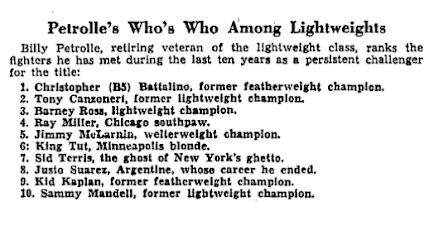
Both fought three-division champion Barney Ross. Petrolle described Ross as "the best boxer" in terms of fighting style. He ranked Ross as the third best opponent he faced during his more than 120-bout career. Ross beat Petrolle twice, once in 1933 and again the next year in Petrolle's last fight. Both were ten-round unanimous decision victories.

McLarnin didn't rank his opponents, but noted, "Barney Ross was a really tough opponent. He was a great boxer and had a great chin. I can remember getting him right on the chin with some of the best shots I ever hit anyone with, and he didn't even blink."

Ross and McLarnin fought three times, each for the welterweight world championship. Ross took the title from McLarnin in their first fight by split decision in 1934, four months after beating Petrolle. McLarnin took it back by split decision later that year. In 1935, Ross won the rubber match by a close but unanimous decision. Each fight was fifteen rounds and McLarnin commented, "Barney was a well-conditioned boy."

"Barney wasn't a great puncher, but he was a terrific boxer," McLarnin said. "He could take a good punch, and he was smart. Especially in the last 10 seconds he'd always finish with a big flurry," much like Sugar Ray Leonard did against Marvelous Marvin Hagler half a century later. Though McLarnin didn't feel Ross hit hard, he explained, "He could stab you pretty good, make you look like a nickel, very embarrassing."

Those fights between Ross and McLarnin were personal for Jewish fans of the day because McLarnin had beaten many of the best Jewish fighters. One of them was Sid Terris, "The Ghost of the Ghetto."

McLarnin knocked out Terris in the first round of their 1928 bout. Before the bout, Terris was the uncrowned lightweight champion and favored to beat Sammy Mandel, who was considered a "cheese" champion in some circles at that time. McLarnin described the fight with Terris: "He jabbed, I stepped outside with an overhand right and caught him right on the chin, and he fell on his head."

Terris had fared better against Petrolle in a ten-round bout two years earlier. Sid took a ten round decision against "The Fargo Express" in Brooklyn. That fight caused Petrolle to declare later, "Terris is the fastest thing I ever saw." Petrolle rated him as the seventh best opponent he faced, just behind King Tut, the boxer from Minnesota, not the boy pharaoh from Egypt.

The ninth best opponent Petrolle faced was featherweight champion Kid Kaplan. In 1926, three months before Billy fought Terris, Kaplan won a ten-round decision over Petrolle in a lightweight bout. Since both men were well above the featherweight limit, the title was not at stake.

McLarnin beat Kaplan by eighth round KO the next year, but he said of Kid, "Oh- he could hit. He knocked me down three times in 1927 and broke my jaw." This lightweight bout came after Kaplan had relinquished the featherweight crown because he could no longer make the weight. "The first punch he hit me broke my jaw, and I'm in terrible shape."

McLarnin continued, "He keeps knocking me down and I keep getting up. And, all of a sudden, I notice after the fourth round that Kaplan's getting awfully tired from hitting me." McLarnin landed a right and scored a knockdown himself. "I knocked him down about ten times and I'm getting so arm weary, so we're both exhausted, especially me." In the eighth, McLarnin "hit him with a right hand and down he goes, and that was it."

Petrolle didn't fight Jackie Fields or Benny Leonard, so they didn't make his top ten opponents, but McLarnin faced both. "Jackie Fields was a real great champ," McLarnin said. "I fought him as a featherweight. He had just come back from the [1924] Olympic Games." The fight was actually over a year later. In those days, it took longer to travel across the Atlantic Ocean, but not that long!

"I believe he had trouble making weight for me," McLarnin said. "I caught him early, second round. I just happened to get lucky. I knocked out Sid Terris with the same punch. Jackie was a great jabber." McLarnin concluded graciously by claiming he had simply caught Fields cold.

On October 7, 1932, McLarnin faced Benny Leonard, who was in the midst of an ill-fated comeback. "Benny Leonard was my idol when I was young," McLarnin explained. "He must have been one of the the great fighters of all time. He was a pretty fat man when he fought me... I had a bad habit of leaning under a right hand, and the very first punch that he hit me, I saw a million stars." The rest of the fight was a forerunner to Larry Holmes battering his idol Muhammad Ali nearly 50 years later. McLarnin later declared of Benny, "He was a tough old cookie."

For his part, Petrolle, who lost two out of three battles against McLarnin, felt Jimmy was overrated despite ranking him as the fifth toughest opponent. "He had ten pounds on me in weight," Petrolle argued. BoxRec asserts McLarnin's advantages were three, four, and seven pounds in the three fights. "He was the scourge of small children- Al Singer, Ruby Goldstein, and that kind- and old men, like Benny Leonard."

McLarnin, conversely, was magnanimous about Petrolle, "Billy Petrolle hit me as hard as anyone ever did. He was a tough, tough guy."
Sources
Gutsky, Earl. "An Old Warrior: McLarnin, 81, Recalls Hard Days of Boxing." Los Angeles Times. Sep. 26, 1989.
Heller, Peter. "In This Corner...!" 1993, 1994.
Neil, Edward. "Billy Petrolle Asserts M'Larnin is Overrated." Los Angeles Times. Jan. 26, 1934. A14.

Friday, January 28, 2022

Review of Boxing in Atlantic City

Boxing in Atlantic City
By John DiSanto and Matthew H. Ward
Arcadia, 2021

I love Arcadia's Images of America series, and Boxing in Atlantic City by John DiSanto and Matthew H. Ward is no exception. These books have short introductions to each photograph-filled chapter. The captions are usually information-stuffed paragraphs.

Boxing in the New Jersey oceanside town started in the 1800s and chugged along until the 1960s. Many of the city's fights took place at Waltz Dream Arena. Convention Hall became another important local venue for the sport. It housed Joey Giardello's decision victory against Dick Tiger in their fifteen round fight for the world middleweight championship in 1963.

And then, nothing.

There were no more boxing matches in Atlantic City until 1973. Promoter Frank Gelb brought the fights back to the shore. With the legalization of casinos and their entry into the boxing business in the late 1970s, Atlantic City became a real hub of the fight game during the 1980s. From the 1990s onward, Atlantic City's importance in boxing has waned, but fans still flock to the occasional big fight.

Boxing in Atlantic City features photos of many of boxing's most important fighters including Harry Greb, Sugar Ray Robinson, Bob Montgomery, Sandy Saddler, Sugar Ray Leonard, Aaron Pryor, Marvelous Marvin Hagler, Thomas Hearns, Roberto Duran, Mike Tyson, Julio Cesar Chavez, Pernell Whitaker, Oscar De La Hoya, and Floyd Mayweather just to name a few. There's also a collection of lesser-known but significant figures such as Harry Wills, Sam McVea, and George Godfrey. All of these legends tended to have a fight or two in Atlantic City. In addition to the all-time greats, this book chronicles boxers who were based in Atlantic City; Arturo Gatti is, of course, one example. There are a couple pictures of heavyweights fighting kangaroos too, in case that's your thing.

Jewish boxers Benny Bass, Maxie Rosenbloom, and Mike Rossman are all featured while other Jewish boxers merit briefer mentions. Countless Jews worked outside the ring in Atlantic City and many are pictured in the book.

If there's a criticism it's that many of the photos are portraits of the boxers. These are great, but the best photos are the action shots and those of the old venues. Nevertheless, the writing provides a strong complement to the many irresistible images. Boxing in Atlantic City is a great jumping off point to learn more about the history of the sport in Atlantic City and beyond.

Tuesday, January 25, 2022

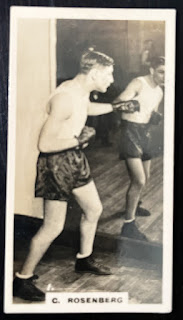
A Backwards Look at Charley Phil Rosenberg

Charley Phil Rosenberg died in New York on March 12, 1975 at the age of 72. Married to the same woman for a half century, Rosenberg retired after 30 years in the insurance business in the 1960s. It was a surprisingly quiet second act for the scandal-ridden former bantamweight champion of the world.

Before the insurance business, Rosenberg was a bootlegger. He had retired from boxing early in 1929 and needed to make a living. With Prohibition still the law of the land and Rosenberg's rough upbringing, it seemed like a natural enterprise for a tough street kid with a large family. Rosenberg had been friends with another illegal businessman, Al Capone. "Capone was a great host," Charley said. "After every fight, he entertained us royally." Rosenberg stayed in this line of work until Prohibition was repealed in December of 1933. That's when Charley transitioned to the far more legal insurance business.

On January 4, 1929, Rosenberg whipped former featherweight champion Johnny Dundee in a ten round comeback fight. "I didn't lick no Johnny Dundee," Charley admitted, "I licked an image of Dundee." Having been knocked down in the fight, he reasoned, "If a guy like Dundee, who couldn't punch, could knock me down, it's time to throw the gloves in." The 26 year old fought only twice more- both in February- before becoming a bootlegger.

Rosenberg lost the bantamweight title on February 4, 1927 despite defeating Bushy Graham. "I gave Graham a licking," Charley boasted of his fifteen-round rout of the challenger. But Rosenberg had come in four pounds over the bantamweight limit. Graham weighed in under the 118 pound limit, so if he had won the fight, he would've been champ, but since Rosenberg won, the title became vacant. Frustrated at losing his title, Rosenberg would have still continued his career, but the New York commission suspended him again, this time for a year. A supposed secret agreement between Rosenberg and Graham to come in over the weight was revealed in an investigation. "Graham did nothing wrong," Charley argued. "Graham come in under the weight." Rosenberg retired from boxing for a time due to the suspension.

After his first title defense resulted in his first suspension, Rosenberg fought often, but didn't defend his crown again for a over a year and a half because he had trouble making weight. A month before he finally defended his belt against Bushy Graham, Rosenberg fought Benny Schwartz, a fellow Jew and former world title challenger at flyweight.

On July 23, 1925 in Madison Square Garden, Rosenberg faced Italian Eddie Shea in his first title defense. Shea came out strong, but body work in the third turned the fight for Rosenberg, the champion. After scoring a knockdown in the fourth, Shea got off the canvas in time to absorb a tremendous right. Though Shea was knocked out cold, the New York commission saw something fishy in the fight and conducted an investigation. As a result, Rosenberg was suspended indefinitely but allowed to keep his title.

A month after winning the title, Charley fought in an over-the-weight non-title bout against Clarence Rosen in Toledo, Ohio. A fan standing ringside at the Armory kept screaming, "Kill the Jew bastard!" Charley went back to his corner after the round indignant at the abuse. "I turned around, took a mouthful of water and blood, and I spit it right in his face," he explained. The fan turned out to be Bernard Brough, who happened to be the mayor of Toledo. "I apologized," Charley continued. "I told him I didn't mean it. You see, out of town a Jew never stood a chance."

"Every town I went to I started trouble [on] account of the Jew situation," Rosenberg said.

On March 20, 1925, Rosenberg faced world bantamweight champion Cannonball Eddie Martin. Many felt Charley Phil would be in for a tough fight because he had to lose so much weight before the fight. Martin pounded Rosenberg for the first five rounds, but improbably Rosenberg turned the fight in the sixth and bashed the champion for the next nine rounds to take the title by unanimous decision. At 20 years old, Charley Phil Rosenberg was bantamweight champion of the world.

In the run-up to his championship bout against Martin, Rosenberg had to lose 36 pounds to make the 118 pound bantamweight limit. Ray Arcel and Whitey Bimstein whipped Rosenberg into shape. "I used to gain 15, 20 pounds every night after a fight," Charley admitted. "I was inclined to be heavy... I was a bantamweight in the ring but not outside. Outside I was really a heavyweight."

In those days, fighters dried out to make weight. For Rosenberg, he drank a cup or two of tea a day, but didn't drink any water; he only gargled it. "Making weight is what made me quit," he revealed. "I used to get up in the middle of the night and cry. I got up and cried many a night. Not pain. Thirst."

Rosenberg weighed 116 pounds, two pounds under the bantamweight limit, for his fight against Martin.

Between 1923 to 1925, Rosenberg overcame his early struggles and began dominating opponents. His style was come-forward all-action. One writer described him as a pint-sized version of welterweight champion Jack Britton. Charley explained, "When I was in there every fight was a war. People pay to see blood. Well, I either gave them my blood or somebody else's."

In 1923, Rosenberg was the idol of his Harlem neighborhood. He had defeated Harry London, a neighborhood rival, on September 22 at the Commonwealth Sporting Club by twelve round decision. "Then I became a neighborhood idol," Rosenberg declared. "I was a popular kid around New York."

It hadn't always been that way. Rosenberg credited Benny Valgar, a Jewish lightweight born in France, featherweight Joe Dellago aka Battling Reddy, Arcel, and Bimstein for teaching him how to fight. Rosenberg began to turn his career around and looked like he might make something of himself.  But prestige was never his aim. His goal was to make money for his family. "I wasn't it in there for no glory," Charley explained. "I was for dollars and cents, because I had a mother and eight other brothers and sisters. We all needed to live. We all needed to eat."

When he became a boxer, he changed his name to Charley Phil Rosenberg. The young pugilist struggled at the outset of his career. "I lost my first eight fights," Charley claimed. BoxRec researchers found a couple wins and draws in there, but the point remains. Rosenberg fought Olympic gold medalist and future flyweight world champion Frankie Genaro twice in 1922. "He gave me an unmerciful licking," Charley admitted. "In fact, he's the one that gave me a cauliflower ear."

At 15 years old, Charley Green delivered wet wash with a boy named Phil Rosenberg, who moonlighted as a boxer. Rosenberg fell sick one Friday, so Charley asked for Phil's boxing license to take his place. Charley needed the $15 the fight would provide. He had no experience outside of street fights, but the ruse worked, and after getting in the ring, Charley was hooked. "I was always fighting in the street. But they couldn't hurt you with the gloves," Charley said, so he decided to become a boxer.

"I was a rough kid in the street," Charley remembered. He worked when he could and stole when he couldn't work. His mother Rachel Green, a widow, couldn't feed her nine children. She placed three of Charley's brothers in an orphanage. Charley was too small at the time, so Rachel carried him as she pushed her peddler's cart trying to make ends meet. The family would move to Harlem when Charley was a boy.

Charles Green was born on August 15, 1904 on the Lower East Side. A few months before he was born, his father, a garment worker, had been crushed to death by an elevator. The family had been poor before the accident and with another mouth to feed on the way, the prospects for baby Charley's life appeared to be tragically bleak.


Bibliography
Blady, Ken. The Jewish Boxers' Hall of Fame. 1988.
Heller, Peter. "In This Corner...!" 1973, 1994.
Silver, Mike. Stars in the Ring. 2016.