Have news relating to Jewish boxers? Email the editor here!
Showing posts with label reviews. Show all posts

Wednesday, May 6, 2026

Review of Ring Theory

Ring Theory: Meditations on 35 Years in Boxing
By William Dettloff
Winding Road Stories, 2025

No one would argue that the past 35 years has signified a golden age of boxing writing. As the sport becomes increasingly niche in the United States, fewer of the great writers concern themselves with the wild contradictions of boxing. Former senior writer at The Ring and editor-in-chief of Ringside Seat William Dettloff, however, is an exception.

A collection of nearly four dozen articles, Ring Theory shows Dettloff's talent for weaving together a good story with empathy for the fighters, humor, and wisdom. He covers all the big events and top fighters from the past three-plus decades with fluidly-presented narratives and distinguished description. The writing is beautiful without being pompous.

As with any boxing anthology, the collection of articles is somewhat disjointed, but a thesis emerges. Fighters will necessarily continue to fight until the desire is literally beaten out of them. Dettloff experienced that feeling on an amateur level. Quite a few legendary fighters couldn't retire until they were forced to. The end of the careers of Tommy Hearns, Roberto Duran, Julio Cesar Chavez, Mike Tyson, Manny Pacquiao, Evander Holyfield, and Arturo Gatti are all featured. Only Lennox Lewis could walk away after an impressive, albeit grueling, victory.

This topic of legends fighting too long wanders into several sections: "The Fighter's Journey," "The Business," "The Final Bell," and "History." It can feel a bit repetitive at times. In addition, fans of Roy Jones and Pernell Whitaker may not appreciate the articles written about them as they're really the only two fighters who receive sustained criticism. Otherwise, Dettloff shows compassion for the fighters without slipping into sappiness. Articles on his own boxing experience, journeyman Walter Cowans, and reminisces of ten champions were particularly insightful.

Ring Theory is a collection of articles from our era's entry into the pantheon of great boxing writers. It gets to the essence of the sport and is a must-read for fans interested in the boxing's recent history.


Tuesday, January 13, 2026

Boxing in the Catskills: Review of Ringside in the Mountains

Evan Haiman
Baker Street Productions, 2025

Capturing the nostalgic oasis of the Catskill Mountains, the documentary Ringside in the Mountains chronicles the evolution of training in the resort area of Sullivan County, New York. Over twelve rounds of information, the impact of such legendary boxers as Barney Ross, James Braddock, Rocky Marciano, Sonny Liston, Joe Frazier, and Muhammad Ali on the "Borscht Belt" is highlighted throughout the 55-minute film.

Hotels such as Grossinger's, Kutsher's, and the Concord were relics of a bygone era, primarily catering to New York City's vacationing Jewish population. The fighters loved staying at the hotels for two reasons: they were treated well and because of the environment. The combination of the cool mountain air and the isolation, which didn't allow for fighters to get in trouble, enhanced their preparation.

The best part of the film comes at the end when three living legends -  Roberto Durán, Ray Mancini, and Gerry Cooney - share anecdotes from their experiences up in the mountains. A former lightweight champion, Mancini chuckled as he called himself "a token Jew" because he absolutely loved the kosher food served at the hotels. Cooney, a heavyweight, on the other hand, could only eat so much of it because he craved diversity in his cuisine.

Featured in "Round 4," Barney Ross, the three-division world champion, was one of the first to use the Catskills as a home base for his training camp. Historian John Conway gives a great story about Malka Grossinger learning to embrace Ross after initially being suspicious of his profession. However, another pundit - one recently inducted into the Hall of Fame - misrepresents Ross's origin story by claiming he learned to fight as a newsie. Many boxers of Ross's era did indeed learn to fight by protecting their corner in order to sell newspapers, but Ross doesn't appear to be one of them. Barney helped out his father's tiny grocery story until the elder Ross's murder. Douglas Century mentions in his biography of Ross that Barney subsequently "went to work at a variety of low-paying jobs - a movie-house usher, a stock boy at Sears, Roebuck, as a Maxwell Street 'puller,' finagling customers into a dry good store," (pg. 16). He learned to fight by joining one of the many gangs that operated in Chicago at the time.

One misguided anecdote aside, Ringside in the Mountains provokes fond memories even if they're not our own. My grandparents traveled annually from the Bronx to vacation in the Catskills with an army of their friends. Many other Jews with ties to New York have a similar family history. It was a delight to see how their getaways contributed to the careers of some of the best boxers of all-time. Fans of Jewish boxing will enjoy this film.


Friday, October 24, 2025

Review of The Baddest Man

Baddest Man: The Making of Mike Tyson
By: Mark Kriegel
Penguin Press, 2025

When I heard that one of the most prominent boxing writers going today wrote a biography on the well-trodden topic of Mike Tyson, I rolled my eyes and figured it was simply an attempt at a cash grab.

I was wrong.

Kriegel's Baddest Man travels down the same lane as David Halberstam's Breaks of the Game. Tyson is so well-known, there's no way to produce completely new information, but Kriegel manages to find unique angles that truly illuminate Mike Tyson's personality, providing context to his warts, his successes, and everything in between.

In the process of retracing Tyson's early life until his demolition of Michael Spinks in 91 seconds, Kriegel challenges such lazy narratives as Cus and the kid and Robin Givens as gold digger. D'Amato and the great Jewish handball player and fight film collector, Jimmy Jacobs, were less saviors than self-interested enablers. That's not to say they didn't care for the young Tyson, just that they helped mold him into the heavyweight champion of the world at the expense of personal growth. Tyson was merely another in a series of high-profile relationships in Givens's life. If her mother made a mistake, it was bringing Don King into the family's orbit as she tried to put distance between Tyson and his managers, particularly the unlikeable Bill Cayton.

Interviews with a myriad of people who knew Tyson, particularly lesser known folks from his early years, present a fuller picture of the often-caricatured champ. We all know he grew up in a very difficult situation, but it's important to discover just how amoral his upbringing was. That isn't to excuse his often harmful behavior but to show there was nothing innate in Tyson's path. He was a product of his environments: from the drug-pushers and pimps of Brownsville to the bloodsuckers of boxing.

If there's a criticism of this book it's that the author needlessly inserts himself into the narrative on occasion. Certain figures such as D'Amato, Jose Torres, and some writers come across, perhaps unfairly, as villains. Even Tyson's eventual ear-biting incident against Evander Holifield can be traced back to D'Amato, who loved recounting the story of protégé Artie Diamond, a Jewish boxer who bit the ear off the toughest inmate upon his arrival in prison. Former light heavyweight champion Jose Torres, the chairman of the New York State Athletic Commission at the time, acted more like Tyson's protector than a regulator. Other New York scribes are usually deemed as bootlickers or enablers.

As with Matt Bai's retelling of the Gary Hart scandal in All the Truth is Out, Mark Kriegel's Baddest Man deals with a salacious subject in a responsible manner. It corrects false perceptions and adds new information about a globally famous figure. Baddest Man is a must read for the countless legions of Mike Tyson fans.

Monday, May 5, 2025

Review of Fightback

Fightback: The Autobiography of Gary Jacobs
By Gary Jacobs with Colin Grant
Empire Publications, 2025

Gary Jacobs was a world-class welterweight who once challenged pound-for-pound great Pernell Whitaker for all the glory. During his career, he held the British, Commonwealth, and European titles. Well-respected in his native Scotland, Jacobs experienced fame and fortune, before plunging into despair.

In his autobiography, Jacobs presents a raw and honest picture of those low moments. He owns up to his mistakes, clarifying some misconceptions without excusing his actions. His downfall is understandable, even relatable. He comes across as flawed but immensely likable.

A proud Jew, Jacobs provides terrific insight into his mindset, an honest assessment of his opponents, and some fascinating behind-the-scenes revelations. His 1989 defeat in New York to former world champion Buddy McGirt raised feelings of self-doubt for the Glasgow-native, until McGirt beat Simon Brown two years later. Jacob's confidence vacillated from extreme to extreme throughout his career.

Gary's close relationship with Maurice Lewis, for whom the book is dedicated, is evident. His relationships with managers Mike Barrett and Mickey Duff had more nuance than the loving bond between Lewis and his protégé.

Co-writer Colin Grant begins the book with a gut-wrenching scene, vividly painting Jacobs as a distraught figure experiencing his lowest valley. The voice then shifts to Jacobs's. Grant does an excellent job of allowing that clear and forthright voice to shine through. The organization isn't chronological, a tactic which can lead to confusion but is mostly done well here. If there's one criticism, it's that Jacobs's take is so interesting, it's too bad the book isn't longer. The Whitaker fight is covered from every angle, but other compelling fights unfortunately receive less attention.

Fightback is a thoroughly enjoyable read that illuminates that Scottish scene in the 1980s and the world welterweight picture during the early 1990s. It's an engaging tale of a highly successful boxer who hit rock bottom and bounced back. It's highly recommended for all fans who wish to know more about this accomplished and complicated Jewish boxer.

Tuesday, April 8, 2025

Review of Boxing's Greatest Controversies

Boxing's Greatest Controversies: Blunders, Blood Feuds, and Mob Corruption
By Louis Joshua Eisen
Dundurn Press, 2025

In Boxing's Greatest Controversies, Lou Eisen delves deep into eleven significant fights, ranging from a bareknuckle brawl to Mike Tyson's gnawing on Evander Holyfield's ear. Heavyweights dominate the book as Eisen examines the seminal moments from the careers of Jack Johnson, Jack Dempsey, and Muhammad Ali. Legendary lightweights Joe Gans and Roberto Durán are also featured.

Each chapter provides background on both fighters involved and the wider context of the sport at the time. That's followed by a diagnosis of the controversy and its ultimate significance. To avoid spoilers, analysis of Eisen's forcefully delivered conclusions to each controversy, which often buck conventional beliefs, will be omitted from this review.

In providing those conclusions, Eisen carefully and gradually lays out his case for each one. Since a few of the fights he covers took place around a hundred years ago, there's some necessary speculation surrounding Eisen's findings. The writing is at times rhythmic due to the author's frequent deployment of hypophora. A touch of moralizing seeps into the accounts of fistic battles with managers often the culprits of any mischief.

Nine of the eleven fights covered are truly integral to telling the story of boxing. The less important Carnera-Schaaf bout is the weakest chapter because of some inconsistencies. Boxing has produced so many fights that could have been included, it's unfair to suggest any replacement, but it would have been enlightening to read Eisen's treatment of the Jack Britton-Benny Leonard fiasco.

Boxing's Greatest Controversies is a great introduction to the history of the sport through several key fights. This book is an illuminating gateway for those who want to learn about boxing history, but don't know where to start. For those more versed in boxing history, Eisen's conclusions provide fodder for argument about these memorable events by challenging established narratives.

Wednesday, March 12, 2025

Review of The Knockout

The Knockout: Sport's Most Decisive Moment
By Andy Clarke
Aurum, 2024

In The Knockout, Sky Sports commentator Andy Clarke examines the moment a fight is stopped through the perspectives of the victor, the vanquished, the coach, and the referee. The views of Carl Froch, Tony Bellew, David Haye, and Matthew Macklin make up the majority of the book and are its strength.

The fighters share their mentality heading into battle. Most acknowledge that they can- and at some point will- get knocked out, an illuminating revelation. They discuss their fear, their nerves, and their focus. They provide a fascinating window behind the scenes.

Knockouts are broken up into two categories: the one-punch shot and the type that involves breaking down the opponent. Clarke explains everything thoroughly so that someone new to the sport can follow along. However, the insight from the boxers will satisfy a hardcore fan and resonate with current and former fighters.

The Knockout comes up short in some ways, however. It's organized thematically, but the best portions are when the focus is simply on one person for an extended portion. Those parts made Clarke's journalistic introductions, describing where he met the interviewee, more relevant. The chapter on "Fear" left the most to be desired in terms of organization.

The book could've used better editing. Long-winded sentences and inconsistent comma usage probably don't matter to most readers, but those who care will struggle with some parts of the book. The numerous clauses in a sentence can muddle Clarke's points, "Despite my reservations above, I do believe, having discussed it with numerous parties, that 'everything happens for a reason' can be a helpful navigational tool (especially in a career as unpredictable as that of a professional boxer), if employed as a philosophical overview, as an ongoing course of treatment, if you will, rather than as a cure for a specific ailment (pg. 196)." Many of Clarke's sentences are pithy and enlightening, but there are too many tedious ones like this example.

British English and American English disagree on some forms of comma usage. Personally, I favor commas after introductory phrases, the oxford comma, and the consistent employment of commas. It helps make things clearer. For fear of going to deep into a lesson of commas, suffice it to say, this book had its issues regardless of which system is used.

The Knockout had the potential to be mentioned alongside Mike Silver's important Arc of Boxing, but the above issues hold it back. The final fight covered at length, between Deontay Wilder and Joseph Parker, didn't even end in a knockout. But there are plenty of interesting anecdotes to make it worth a read, especially for those interested in the British boxing scene.

Thursday, February 13, 2025

The Unexpected Danny Green is Back

Paul R. Friedman has released an audiobook version of his debut novel The Unexpected Danny Green narrated by Dave Fennoy. The book introduces the heroic character Danny Green, a fictional boxer from Mississippi who moves to New York to pursue his career. Friedman spoke with The Jewish Boxing Blog about his boxing influences that contributed to the writing of Danny Green's journey.

Friedman's interest in boxing was shaped by respected acting coach Sal Dano, who was also well-versed in the sport. Friedman was 18 years old and "out of control" due to unchecked emotions when he met Dano, who came just at the right time for the teenager.

Friedman describes Dano as "powerful and complicated." He got the sense that if Dano turned dark, he could hurt someone, but the coach was both street smart and classically intelligent. Mentor and protégé watched fights together, and Dano analyzed the boxers' movements in a way that went deeper than the understanding of a mere fan, teaching Friedman to appreciate the sport on another level.

Because of Dano's mentorship, Friedman even put on the gloves himself and boxed with friends. He learned not only technique, but also not to fight emotionally. Dano taught Friedman about himself and about humanity and directed his life's trajectory. A secret Paul shared with The JBB is a character in the book is not only based on Dano, but is also an anagram of his name.

Friedman, who worked as Vice President of Creative Content at CBS for decades, once met "Sugar" Ray Leonard backstage at an event honoring Muhammad Ali. Leonard confided in Paul, "Without Ali, there's no Sugar Ray." Ali and Leonard were two of Friedman's favorite boxers, a list that includes Mike Tyson, and a less famous fighter: James "Bonecrusher" Smith. Friedman also marveled at the amount of punishment Joe Frazier took to get inside, and relayed a revealing story about another smaller heavyweight. At a Grammy party, he ran into Evander Holyfield and decided, perhaps unwisely, to put his arm on the champ's shoulder. "I never met someone who was made out of rock before," Paul quipped. Holyfield's shoulders were so muscular they were like "marble."

Danny Green's career was influenced by real life events. In the book, a character illegally wraps his hands with plaster of paris, an episode based on Antonio Margarito's fight against Miguel Cotto. Margarito was caught with the illegal wraps before his fight against "Sugar" Shane Mosley six months later, which led to the belief that he had used the outlawed substance against Cotto, since his punches grew harder as the fight progressed.

Friedman was also moved while watching a fighter get knocked out but continue to throw punches in an unconscious state from the canvas, a sad event featured in the book.

Imagining the younger version of a lithe building super in New York, Friedman created the character of Danny Green with the intention to inspire readers. Green is a well-rounded diamond in the rough, someone who is physically gifted as well as intelligent. It stems from Paul's belief that if we all apply ourselves we can overcome hardship and become successful. Friedman is a living embodiment of that belief.
The audiobook version can be purchased here.

Thursday, December 19, 2024

Review of The Promise of Women's Boxing

The Promise of Women's Boxing: A Momentous New Era for the Sweet Science
By Malissa Smith
Rowman & Littlefield, 2024

Malissa Smith's new book is a celebration of women's boxing since the 2012 Olympics, which is when her seminal A History of Women's Boxing leaves off. In her first book, Smith mainly assumes the role of historian while in this effort she serves primarily as a journalist. Impressively, she wears both hats well.

After the forward by the GWOAT, Claressa Shields, The Promise of Women's Boxing starts with the CliffsNotes version of A History of Women's Boxing to provide context for the modern era. Smith focuses on the recent U.S. and U.K. scenes although she includes the impact of the sport in a variety of countries around the world. The important international amateur tournaments including the Olympics, the pro careers of the stars that arose from those tournaments, the "Old Gang," women's boxing in popular culture, and much more fill the pages.

To cover the length and breadth of such a vast topic is virtually impossible, yet Smith does so expertly. One of the many interesting issues in the book is the tension between the Old Gang of boxers who turned pro before the 2012 Olympics and the amateur standouts like Shields and Katie Taylor who ushered in a new age of prominence for women's boxing. Cecilia Braekhus, Layla McCarter, Melissa Hernandez, and many other fighters performed at a high level in relative obscurity and poverty. Some have been rightfully frustrated at their lack of fame and fortune relative to recent stars like Shields and Taylor.

Another fascinating subject is the complicated relationship between the International Boxing Association (IBA, formerly AIBA) and the growth of women's boxing. The IBA was instrumental in the rise of the sport, creating a category for female boxers in the World Championships and in the Olympics, which propelled the popularity of women's boxing. However, the IBA is a scandal-ridden organization that has since been expelled from running the Olympic boxing tournament. 

This book is truly a remarkable achievement, but it's not perfect. A few typos with names, such as calling Mikaela Mayer's coach "Al Michael" (pg. 113, but correctly written as "Al Mitchell" on pg. 43) and Jermain Taylor "Germaine" (pg. 75), are present. The occasional long-winded sentence crops up, an issue the author admits in the Acknowledgements. There is a slight New York bias, which makes sense considering the author is based in New York and trains at Gleason's Gym.

Though there is so much coherently-organized information, fans of Jewish boxing might be disappointed that Carolina Duer and Hagar Finer aren't in the book. Smith, who is Jewish, mentions promoters Aileen Eaton, Larry Goldberg, and Dmitriy Salita though. Incidentally Smith made a terrific list of the top five female Jewish boxers for The Jewish Boxing Blog last year.

In The Promise of Women's Boxing, Malissa Smith takes an extremely broad subject and manages to create an engaging, informative narrative that captures the climb of women's boxing. Smith is a founding board member of the IWBHF and a voter for the IBHOF, but at some point, she should be right there with the people she helps elect because of her contributions to boxing, this excellent book among them.

Tuesday, November 26, 2024

Review of Then the World Moved On

Then the World Moved On: The Brutal Truth Behind the Max Baer-Frankie Campbell Fight
By Catherine Johnson
Brown Glove Books, 2024

Many Jewish boxing fans have long idolized Max Baer. By reexamining his deadly fight against Frankie Campbell in her wonderful book Then the World Moved On, Catherine Johnson convincingly argues Baer is more deserving of condemnation than idolization.

A son of Italian immigrants, Frankie Campbell first made his name in fistic circles in San Francisco. Something of a crude slugger, he took his fan-friendly style to Los Angeles and eventually became a popular figure among all of California's fight fans. Meanwhile, Max Baer embroiled himself in constant controversy. Ties to the mob and fixed fights defined his early career.

In their fateful fight, Baer first fouled Campbell in the second round after he was knocked down. Referee Toby Irwin failed to clean Baer's gloves and instead watched as he sucker-punched Campbell in the back of the head. In the fifth, Irwin ignored Baer's barrage of unanswered punches as Campbell descended into unconsciousness. Johnson contends this was no accident. Irwin admitted that he let the carnage continue to appease gamblers.

The previously accepted narrative follows that Baer felt extreme guilt over his role in the death of Frankie Campbell as seen by his reluctance to fight all-out against future opponents, and that Baer made a concerted commitment to Campbell's surviving family members. Johnson effectively dismantles those notions. Baer is often given responsibility for the eventually death of Ernie Schaaf, who died six months after Baer beat him mercilessly. The Livermore Larupper pummeled Max Schmeling with no remorse, and later brutalized Primo Carnera to win the heavyweight world championship. In none of these fights did Baer show any reluctance to injure his opponents on account of what he did to Frankie Campbell.

Furthermore, Baer had very little to do with Campbell's family after the tragedy. He boasted of attending Frankie Jr.'s college graduation, but the boy had sadly died in a plane accident months before graduating, so Baer's story was made up. Baer, in fact, didn't even know how many children the Campbell family had, mistakenly claiming they had two sons. Johnson shows that Baer's supposed concern for the Campbell family was a self-serving mirage.

Johnson views Baer's ties to Judaism with skepticism. A genealogist by trade, she does confirm the belief that he had a Jewish grandparent. His sudden identification as a Jew, though, was not merely done to sell tickets to Jewish fans in New York ahead of his fight against Schmeling but because a significant boycott movement had grown in reaction to Schmeling's alleged Nazi ties. Johnson is sensitive to Baer's meaning to Jews, including my grandmother's family. She writes, "By ever wearing the Star of David on his trunks, did Max Baer give hope to Jews during utterly dark days? Absolutely," (pg. 296). But Baer did not truly identify as Jewish in life or in death. A cross decorates his tomb.

To be clear, this book is not a hit job on Baer. Johnson actually idolized the man before delving into the research, even naming her dog after him. Regardless of anybody's sentiment for Baer, the facts are laid out in a way as to make her argument incontrovertible.

More than merely making a case against Max Baer, Then the World Moved On goes into fascinating detail about Frankie Campbell, boxing in California during his era, and much more. There are also many illuminating pictures. Lined with amazing bits of research, Campbell's opponents, managers, and promoters come alive. This book brings readers into the boxing world of that time and place, something only the best boxing books can achieve.

With mountains of research, there are bound to be a few slip ups. These couldn't be more minor. On page 47, it's claimed that Jimmy McLarnin won the lightweight world championship. The two-time welterweight champion beat the reigning lightweight champ three times in nontitle fights, but never won that belt. Similarly trivial, in describing coach George Blake, the author writes, "[H]e had guided Jackie Fields to a [w]elterweight title," (pg. 113). After researching Fields's life the past two years, it'd be a slight to Gig Rooney to give Blake credit for Fields's pro championship. Undeniably, Blake guided Fields to Olympic gold in the featherweight division in 1924, but Blake and Fields had a falling out when Jackie wanted to turn pro after the Olympics and Blake wanted him to wait two years. So Rooney trained and managed Fields through his first welterweight run. A nitpicky critique for sure. More relevant for those who want to use this book as a source, a random sampling of the index shows the pages don't match up in the paperback. These tiny issues don't impact Johnson's argument about Max Baer in the least and hardly detract from the narrative. 

Then the World Moved On is such a good book, There are so many interesting anecdotes and stories to more than satisfy a boxing history lover, but it's written so clearly and explained so well that a beginner to the subject wouldn't be lost. Johnson masterfully finds the balance. The Jewish Boxing Blog highly recommends this book.

Tuesday, May 28, 2024

Review of The Pennsylvania Boxing Hall of Fame

The Pennsylvania Boxing Hall of Fame
By John DiSanto
Arcadia, 2024

The Pennsylvania Boxing Hall of Fame is not an exclusive club. Started in 1958, the names of fighters with modest and even losing records sit beside those of former world champions. Rather than a reward for an elite career, the Pennsylvania Boxing Hall of Fame is a celebration of the breadth of the sport in the state. 

Author John DiSanto's dedication to keeping Pennsylvania boxing history alive as the head of PhillyBoxingHistory, curator of museum exhibits, and chairman of the PBHOF, is inspiring. His third book, The Pennsylvania Boxing Hall of Fame, features fascinating pictures and brief biographies of about half of the many members in the Hall.

DiSanto begins with an illuminating introduction detailing the Hall's journey. From overwhelmingly white and primarily focused on a fighter's popularity, the author has helped guide the PBHOF to a more racially representative and merit-based institution.

The rest of the book is organized into five categories: world champions and International Boxing Hall of Famers, world title challengers, regional and state champs, local heroes, and non-boxers. Within each category, the Hall of Famers are organized alphabetically, which makes the book an accessible reference. The members could have been organized chronologically or by weight class, which would have made for a more cohesive narrative but diminished its value as an easily-useable resource.

Jewish world champions Benny Bass, Battling Levinsky, Harry Lewis, and Mike Rossman, along with IBHOFers Lew Tendler  and promoter Russell Peltz are among the greats that grace the first chapter. World title challenger Danny Kramer makes an appearance. So does local hero Harry Blitman. Harry "Kid" Brown and Benny Kaufman are noted simply in the complete list of members at the end.

The Pennsylvania Boxing Hall of Fame is a terrific representation of the talent that has come out of the Keystone State, particularly the fighting cities of Philadelphia and Pittsburgh. The pictures of boxers from long ago- and not so long ago- are captivating. It's well-worth it for fans of Harry Greb, Joe Frazier, and the countless other notable boxers who have plied their trade just north of the Mason-Dixon line.


Thursday, February 15, 2024

Review of Smash Hit

Smash Hit: Race, Crime, and Culture in Boxing Films
By David Curcio
Armin Lear Press, 2023

In Smash Hit, David Curcio expertly plays the roles of film critic, boxing historian, and cultural commentator. His immense knowledge of film, boxing, and American culture coupled with the way he weaves them all together in almost every one of the twenty chapters (each about one film) is an astonishing achievement. While this book would fit comfortably in a college or graduate level curriculum, it can be enjoyed by anyone interested in the history of cinema or boxing.

Of the five movies discussed that I've seen (it should be noted I'm the antithesis of a cinephile), Curcio provides perfect analysis for four of them. Not only do I agree with his interpretations of those films, but they go beyond what I had considered. The other fifteen chapters are just as informative, and the writing is excellent.

The chapter on Rocky III is the only one in which I disagree with Curcio's view.  He writes, "Adrian is relegated to an ancillary character, once again struck dumb and keeping the film firmly rooted in the male realm." But this ignores the scene on the beach where Adrian delivers a fiery speech to reignite Rocky's passion for boxing after he has decided to quit the sport. It's the moment Adrian breaks out of her shell and forces Rocky to face the harsh truth of his fear. "How did you get to be so strong?" Rocky asks her when the shouting is done. "I live with a fighter," Adrian's replies. Overly ambitious, the context provided in the Rocky III chapter doesn't flow as seamlessly as in all the others. Instead, it reads more like a series of tangential asides.

The only other section that isn't top notch is about Gentleman Jim and only because of a few minor factual errors, mostly involving dates, such as Jim Corbett's career being placed in the 1880s instead of the 1890s (dates for Ali-Frazier I & Lewis-Tyson also have typos). In that chapter, Curcio discusses a Corbett foe, Joe Choynski, one of many Jewish boxers, actors, and characters covered.

Tons of Jewish history is present here. Curcio delves into the story of actor John Garfield and other Jews who were blacklisted or targeted by the House Un-American Activities Committee. Edward G, Robinson is just another of the many Jewish actors mentioned. There are great anecdotes such as when Mushy Callahan doubled for Errol Flynn during the boxing scenes in Gentleman Jim. Barney Ross is the subject of a couple of the movies covered. So is Max Baer. And who could forget Rocky's trainer Mickey Goldmill? Those are just some of the Jews featured in these pages.

In Smash Hit, Curcio shows he is a writer of the highest quality. There is no one better suited to cover the blend of boxing and film and, any disagreements aside, the book is executed brilliantly. Whether or not you've seen any of the movies featured in Smash Hit, it's definitely worth reading.

Sunday, January 21, 2024

Review of Murder on Federal Street

Murder on Federal Street: Tyrone Everett, the Black Mafia, Fixed Fights, and the Last Golden Age of Philadelphia Boxing
By Sean Nam
2023

Pretty southpaw Tyrone Everett was the talk of South Philadelphia during the 1970s. Seemingly a future champion who vacillated between outboxing his opponents and standing in the pocket and knocking them out, Everett's life was snuffed out in the house of one of his girlfriends, a woman who happened to be the estranged wife of a Black Mafia leader. The girlfriend, Carolyn McKendrick, allegedly pulled the trigger in a jealous rage although some close to the case believe she took the fall for more powerful figures who were actually to blame for the murder.

In Murder on Federal Street, Nam does a masterful job recounting Everett's career. Torn between his reality as a local star and his aspirations of world fame, Everett is a complicated and imperfect man, one who lived a thought-provoking life. The writing is superb and the research intricate and illuminating. The shorter sections on race relations in Philadelphia and the role of the Black Mafia in the city provide excellent context. If there's anything to quibble about this book, it's that those sections could have been woven into Tyrone Everett's story a little tighter.

The truth is, there is virtually nothing to criticize. Nam uses high-minded references and an elevated vocabulary that would make a professor of literature reach for a thesaurus, but impressively manages to create an unpretentious and effortless read. The topics of murder and the mafia lend themselves to sensationalist coverage, but Nam treats them with empathy and humanity.

Throughout his career, Everett had a close relationship with his manager, Frank Gelb, but a frostier one with his promoter Russell Peltz, both of whom are Jewish and act as main characters in the drama. Though not Jewish himself, Everett wore a Star of David on his trunks in several of his fights. Nam concludes he did so to channel the popularity of his rival Bennie Briscoe. Briscoe, who fought in a much higher weight class but often received top billing above Everett, wore a Star of David on his trunks to honor his manager. Yiddish words are not only sprinkled into the narrative, but thankfully are used appropriately. Nam even scores a rare interview with former world champion Mike Rossman.

Murder on Federal Street is a fascinating story and a fantastically written book. It's highly recommended reading for any boxing fan, particularly those interested the sport's history in Philadelphia or during the 1970s.

Thursday, September 21, 2023

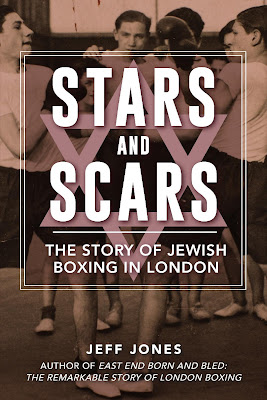
Review of Stars and Scars


Stars and Scars: The Story of Jewish Boxing in London

By Jeff Jones
Amberley Publishing, 2023

Jeff Jones's noble mission in Stars and Scars is to show "the importance of Jews to sport" and to dispel "the perceived notion that their involvement was marginal." Through plenty of fascinating anecdotes, biographical sketches, and wonderfully illuminating information, Jones more than meets his aim.

He contends, "From Mendoza to Milch, 230 years of London Jewish boxing has witnessed some astonishing events." Jones recounts the enthralling lives of men like the colorful Cockney Cohen, the slick Harry Mizler, the elite Ted "Kid" Lewis, the incomparable Micky Duff, the whirlwind Jack "Kid" Berg, the veteran Sid Nathan, and many more.

A scattershot organization and the need for a good line edit prevent this book from being on the "Mount Rushmore" of Jewish boxing books, however. Everything from bareknuckle brawlers to stars, journeyman, promoters, referees, and venues are covered. There are chapters on boxing families and boxers who fought in war. The piecemeal stories of Berg, Mizler, and Lewis - to name a few- could have been more powerful if they had been weaved into a chronological narrative that provided clearer context for their careers. The terms "reasonable" and "useful" are overused to described serviceable fighters, admittedly a minor quibble.

The organization does serve to prove the author's argument: that Jews were featured in every nook and cranny of boxing in London for nearly 200 years. Though the wealth of information is vast and somewhat disjointed, it is eminently accessible, which makes Stars and Scars a great introduction for all readers to Jewish boxing in London. Its focus on breadth rather than depth makes it an appropriate jumping off point to learn more about these legendary Londoners. Experts and those with limited knowledge of the subject can't help but learn a ton while simultaneously being entertained.

Fans of Jewish boxing and of British boxing should have Scars and Stars in their personal libraries. The richness of boxing history within its pages easily outweighs any of its shortcomings. 

Thursday, September 7, 2023

Review of The Fighter of Auschwitz

The Fighter of Auschwitz: The incredible true story of Leen Sanders who boxed to help others survive
By Erik Brouwer
Cassell, 2023

Leen Sanders of Rotterdam, Netherlands was one of the best European boxers of the late 1920s and for much of the 1930s. He began as a featherweight and climbed through the lightweight, welterweight, and middleweight divisions. Known for his "double defense," Sanders was a short, stocky, and powerful man whose fighting style was- contrary to his stature- that of a technical boxer.

When the Nazis invaded the Netherlands, Leen's fortunes quickly took a terrible turn because of his Jewish heritage and his activities in the resistance. He and his family were eventually sent to Auschwitz, the most notorious of the Nazis' camps. Sanders's boxing prowess won him special treatment at the concentration camp. He used his relatively privileged status to help as many people as possible, but he couldn't save his family.

Erik Brouwer's The Fighter of Auschwitz is an incredibly written story. The descriptions and pacing before the war befit a classic novel. The author paints an amazingly vivid picture of the European boxing scene during the '20s and '30s. Because of Brouwer's considerable talent as a writer, the book would've been even better if Sanders's boxing matches had been detailed in depth. His engaging depiction of Leen's fight against Teddy Pietrzykowski for the all-weights championship of Auschwitz is an exception. Considering the situation, it's a remarkably extraordinary recounting.

Appropriately, the tone changes when the story reaches the Holocaust. Compared to many other books about the Shoah, The Fighter of Auschwitz is not quite as soul-crushingly sad. The privileges afforded to Sanders made his internment not as horrific as it could've been, and his selfless heroism while in the camp shows glimpses of human generosity in the face of utter cruelty. Brouwer also wisely pulls punches when it comes to the tragic ends of Leen's loved ones. In those instances, he foregoes unnecessary flourishes and thankfully avoids drawing out their deaths in an emotionally manipulative manner. The inmates' experiences in Auschwitz are detailed but not superfluously so.

A must-read for fans of Jewish boxing and for those learning about the Holocaust, The Fighter of Auschwitz should be read by everyone. In this moment of heightened anti-Semitism, this story has the potential to change minds for the better.


Other resources: The Jewish Boxing Blog's Holocaust Boxing page.

Tuesday, June 20, 2023

Review of Baseball, Nazis & Nedick's Hot Dogs

Baseball, Nazis & Nedick's Hot Dogs: Growing up Jewish in the 1930s in Newark
By Jerry Izenberg
The Sager Group, 2023.

Baseball, Nazis & Nedick's Hot Dogs is a memoir that covers the early life of legendary sports writer Jerry Izenberg from a graphic depiction of his bris until he leaves his family to join the military during the Korean War. The portion in between shows what it was like growing up in Newark during the Great Depression and World War II.

Jerry was a preconscious kid who sometimes caused mischief. His mother was a tough strict woman. Jerry connected with his father, a former minor league baseball player who often imparted wisdom, through their love of the Newark Bears and the New York Giants. As he reached adolescence, Jerry hustled to make money and took a sophomoric interest in girls' anatomy.

It's a very Jewish memoir. That aspect of Izenberg's identity defined him. A key underlying message of the book is that there isn't one way to be a Jew. A person who battles anti-Semitism on the ballfield is a Jew just as much as a famous rabbi overseeing a bar mitzvah. As Jews, we're all part of the same family regardless of our level of observance or our political ideology.

Though baseball is the most important sport in young Jerry's life, references to boxing make their way into the book. Jerry even tries his hand at boxing for a brief period. He shows heart, but let's just say Jerry Izenberg won't be profiled in The Jewish Boxing Blog for his pugilistic merits. George Kornfeld, who Izenberg describes as a middleweight, trains Jerry so he won't get beat up at school. Izenberg also mentions a bit of wisdom from the legendary train Ray Arcel, "Hard times make monkeys eat hot peppers."

In military school, Jerry played the clarinet and then the baritone horn in a band. In addition to his clever analogies, his musical timing contributes to his mastery as a writer. He notes, "The idea of rhythm, pace, and the joy of improvisation was the music I came to respect back then, and the concept stays with me today. I find those ingredients easily translate from one art form to another. Today, they are my silent partner in everything I write as a columnist and as an author (pg. 46)."

Baseball, Nazis & Nedick's Hot Dogs is a fascinating look into the formative years of a legendary Jewish sports writer.

Tuesday, June 6, 2023

Review of Family, Gangsters & Champions

Family, Gangsters & Champions: Boxer Tony Canzoneri's Life & World
By Ramon Antonio Vargas
La Nouvelle Atlantide Press, 2023

Tony Canzoneri was a five-time, three-division world champion who learned to box in New Orleans before his family moved to New York. After linking with manager Sammy Goldman, Canzoneri quickly moved up the ranks. Despite some setbacks along the way, Canzoneri would achieve greatness by taking on all comers and beating many of the best fighters of his era. One motivation for his success in the ring was to bring prestige to his family's resort in upstate New York.

In Family, Gangsters & Champions, Ramon Antonio Vargas shows he is an expert on New Orleans. Though Canzoneri's time in the Big Easy was cut short by his family's move, there are many fascinating and relevant tidbits about the city. Amazing anecdotes about Canzoneri's life fill the pages. Before Tony's debut, his opponent bet his entire purse on himself. When Tony ran into the man years later and heard the story, Canzoneri treated the opponent to a meal and drinks. The moment when Canzoneri's lifeless body was discovered in his hotel room many years later, ex-rival Al Singer was sitting at the bar of Tony's restaurant praising his former foe. These incredible details are part of the strength of the book.

Vargas's coverage of the fights is accessible- a footnote even explains how boxing matches are scored- but this isn't the best part. The author doesn't always use traditional boxing lingo, which is fine because the meaning is usually clear, but he does describe Canzoneri's non-title over-the-weight bouts as "exhibitions," a word that has a very specific meaning in boxing. It's important to note these matches were sanctioned fights that counted towards the fighters' records, not exhibitions.

The 1920s are often remembered as the golden age of sports writing, but anyone who has read recaps of random fights from the era will tell you there were plenty of meaningless references to two-fisted attacks to the head, jaw, and body as well. Without the benefit of much video footage of these old fights, modern historians are limited by the quality of contemporary coverage. That reality can leave the summaries of Canzoneri's fights a bit uneven. Some are exciting, but a couple aren't particularly informative. Aside from a few fights though, Vargas's writing is smooth, clear, and thoughtful.

Tony Canzoneri fought many Jewish boxers and quite a few are present here. After his debut, he's a 30-fight veteran three pages later, so there are only brief mentions of Danny Terris and Archie Bell, and nothing on Young Montreal. But there's a lot more on Benny Bass, Jack 'Kid' Berg, Harry Blitman, Barney Ross, Al Singer, and Al "Bummy" Davis, including short vignettes about what become of each at the end.

A couple of nitpicky issues about Jewish boxers: Singer is described as a bit taller here than in most sources and is called "the Bronx Flash," perhaps a lesser-used nickname, but Singer's primary alias was "The Bronx Beauty." Had Canzoneri's left hook knocked down Barney Ross in the eleventh round of their rematch, it's claimed that Tony would've gotten "at least a two-point edge for that round (pg. 126.)" But this was quite a bit before the ten-point must system, so a round only counted as a round regardless of any knockdowns. The biggest miss involves three Jews. The author says Berg won his junior welterweight world championship from Joe Glick (pg. 92), but Berg lifted the title from Mushy Callahan, who had held it for four years. Glick, a very good fighter that never won the title, was the victim of Berg's first defense.

Mushy Callahan's decedents might disagree, but Family, Gangsters & Champions.is well-researched overall. Using interviews and relatives' memoirs, the importance of the resort to the Canzoneri family can't be missed. Gangsters such as Joe Bananas spent their summers at the compound. A distance relative of Tony's even once shot Joe Bananas's son in the ass with a BB gun. The relative survived the ordeal.

This book is for a few distinct audiences. Those new to boxing will be able to follow along and appreciate the complex family dynamics at play. Readers who know some boxing history but want to move beyond the Muhammad Ali-Joe Louis paradigm will learn a lot. Those who love boxing history will savor the anecdotes. Family, Gangsters & Champions will available on June 29.

Update: Author Ramon Antonio Vargas said he corrected the errors mentioned in this review.

Wednesday, May 31, 2023

Review of Matthew Saad Muhammad

Matthew Saad Muhammad: Boxing's Miracle Man
By William Dettloff
McFarland, 2023

Abandoned under the Ben Franklin Bridge in Philadelphia as a four year old, Matthew Saad Muhammad would rise to the heights of the boxing world as light heavyweight champion and the sport's most exciting fighter. In Matthew Saad Muhammad, William Dettloff narrates the incredible journey that took the charismatic boxer from the bottom rung of society to the top and back down again.

After he's abandoned, Matthew is adopted and given the surname Franklin because of the bridge where he was found. Understandably, he finds trouble as a young man but discovers his purpose inside a boxing ring. A slick boxer early in his career, Matthew changes course after a couple of dubious decisions don't go his way. He transforms into an all-action brawler, one who can ignore the blood streaming down his face in order to win.

After capturing the WBC light heavyweight championship from Marvin Johnson, Matthew announces that he has converted to Islam and changes his name to Matthew Saad Muhammad. An active champion, Matthew remains in the limelight for the next two-and-a-half years until he loses his title to Dwight Braxton. Matthew's career soon unravels, and he spends his remaining days as a fighter dreaming of reclaiming the title that surely will never come back to him. His years after boxing see him teetering on the edge of having his life together and everything falling apart, all while he believes he will recapture fame and fortune. His life is at once inspirational and dispiriting.

Matthew Saad Muhammad is a flawed man, and Dettloff treats him with the appropriate amount of empathy. Matthew isn't lionized nor is he demonized here, and that is one of many strengths of the book. Though his early career is perhaps glossed over too quickly, the rest of Matthew's life and career is compelling. The writing is smooth, the fights are gripping, and the reporting is fair. The only reason to put down this book is to go watch Matthew's old fights on YouTube.

Several Jews make appearances in the book. Mike Rossman is an important character throughout much of Matthew's life. Rossman isn't portrayed in a flattering light here. He comes across as entitled, his accomplishments are downplayed, and his dad doesn't believe in him. Nessim Max Cohen makes the briefest of cameos. J. Russell Peltz, the prodigious Philly promotor, was instrumental in putting together some of Matthew's early fights. Peltz's book Thirty Dollars and Cut Eye complements Detloff's book well. Many of the same names appear in both, but there isn't much overlap.

William Detloff's Matthew Saad Muhammad is highly recommended reading. Everyone who enjoys reading about boxing will appreciate it. For fans of 1970s and 1980s light heavyweights specifically, this is a must have.

Monday, May 22, 2023

Review of Tony Canzoneri

Tony Canzoneri: The Boxing Life of a Five-Time World Champion
By Mark Allen Baker
McFarland, 2023

Tony Canzoneri, born on the outskirts of New Orleans and raised in Brooklyn, became only the second ever three-division world champion in boxing history. Yet, his name is often left out of discussions of the greatest ever. In his biography of the former featherweight, lightweight, and junior welterweight champion, Mark Allen Baker aims to set the record straight.

By chronicling all of Canzoneri's fights, Baker makes it impossible to dispute that Tony was one of the best of all-time. The difference between the fighters of today and nearly a hundred years ago is made clear: Canzoneri fought better opposition in any given year than many current contenders do throughout their entire careers. In mostly straight-forward prose, Baker also gives a window into how fighters were managed in the 1920s and 1930s by following Sammy Goldman's machinations in orchestrating Canzoneri's career.

This book is not for boxing history beginners. In addition to every one of Tony's fights, other bouts on the same card are also referenced. Baker ticks off key opponents of Canzoneri's opponents, and even more monikers rush in when he adds the wider boxing context. Though Baker provides background for many of the boxers, for those without a college-level grasp of the lighter divisions in the '20s and '30s, reading this book is akin to jumping out of a plane without a parachute. There is an ocean of names.

For those who can tell Joe Glick from Frankie Klick, the book is very informative. The negatives are minor. At one point, Canzoneri is said to have challenged Johnny Jadick for the junior lightweight title instead of the junior welterweight title (pg. 89). Baker occasionally fixates on a word, such as when he describes Canzoneri as "compact" four times by page seven. His choice of the word "opposer" instead of "opponent" would work is if it wasn't so distractingly relentless. More importantly, we get a sense of Tony Canzoneri the boxer, but not Tony Canzoneri the man until after his career is over.

For Jewish boxing fans, the biggest negative is the author's apparent antipathy towards our hero Barney Ross. Baker is fair with everyone except Ross. When Ross relinquished his lightweight championship, Baker claims, "Frankly speaking, Ross would rather quit than lose his title." He later adds Ross was "afraid to defend his lightweight title."

By this point, Ross had won the welterweight world title and lost it back to Jimmy McLarnin. Of Ross, Baker admits, "[T]he fighter's frustration with losing weight was widely known." He continues, "Matching with McLarnin, Ross believed, had greater economic potential than Canzoneri and  [Lou] Ambers combined," (Quotes about Ross from pgs. 126 & 129).

So Ross had trouble making the weight, could make a lot more money fighting at a heavier weight for the title and yet he was so afraid to face Tony Canzoneri, a man he had just beaten twice, that he quit his title rather than lose it?  It makes no sense. Fortunately, this logical fallacy is an anomaly in the book.

The few pages of attacks against Barney Ross aside, Tony Canzoneri is filled with great coverage of many Jewish boxers. Glick, Benny Bass, Al Singer, Jack Berg, Bummy Davis, Harry Dublinsky, Al Roth, Danny Terris and Sammy Dorfman are just some of the Jewish boxers Canzoneri faced that are recounted here. Though the main protagonist is an Italian Catholic, the book is filled with wonderful Jewish boxing history.

Mark Allen Baker's well-researched book, Tony Canzoneri, is for knowledgeable boxing fans who want to relive a bygone era. Fans of Jewish boxing will love reading about the exploits of countless Jewish fighters. Just ignore the unfounded Barney-bashing.

Friday, October 14, 2022

Review of the Unexpected Danny Green

The Unexpected Danny Green: From Mississippi to Manhattan, Harlem to Hollywood... Boxing was Just the Beginning
By Paul R. Friedman
2022

Danny Green, the main character of Paul R. Friedman's debut novel, grows up in segregated Mississippi, moves to New York to pursue a pro boxing career, and then to Los Angeles to become an actor. Intriguingly, Friedman has written a comprehensive biography of a fictional character.

Green's somewhat Pollyannaish life is occasionally interrupted by events such as incidental run-ins with the mob and getting trapped in a hurricane while on vacation. Because it's written like a biography, there's no real story arc. The pacing speeds up during bursts of action and slows down during intimate moments of relaxation, adding depth to the story and mimicking life. As a character, Danny Green is admirable if not relatable or altogether realistic. He's stoic and heroic. He writes moving essays for the New Yorker, never fights with his wife, and knocks out criminals.

Boxing fans will appreciate The Unexpected Danny Green although there are some anachronisms. Green turns pro in 1978 and is on a non-televised portion of a Showtime card. Showtime didn't begin to broadcast boxing until 1986. HBO and ESPN are also given significance far earlier than was the case. At some point, dates within the story become blurred, but the use of endswell in Green's corner during the Julio Ramirez fight may have come just before it was invented.

Novelists, of course, are allowed to manipulate the facts to fit their narrative, but there are a couple of inconsistencies within the book's own logic. Green was 16 years old in 1974 when he took up boxing, but in 1976, we learn "A few years earlier, he had started competing in the regional Golden Gloves tournaments." Green's entire boxing career is difficult to place. He's an Olympic alternate who begins his career in a six-rounder at Madison Square Garden. But no one in the sparse crowd has heard of him, and he has to travel to his opponents' hometowns for his next several fights. Without providing spoilers, the rest of his career is curious as well.

Nevertheless, there's a lot to like about the boxing portion of the story. Green trains at Gleason's and there is a discussion of the 1976 and 1984 U.S. Olympic boxing teams. But the true strength of the book is in the description of Danny and his wife's lavish vacation spots, and in his journey as an actor. You feel like you're soaking in the scenes with the couple whether they travel to St. Thomas or Italy. Green's progression as an actor is meticulously described, from his coaching to his meetings with his agents to his time on set. It's an entertaining guide to Hollywood from a true expert.

The Unexpected Danny Green features Jewish characters and boxing, but the two rarely meet. It's a fun read about a likeable main character written in a conversational tone filled with vivid details. Though fans of Hollywood will get the most enjoyment out of the novel, there's a Jewish ethos and enough boxing for fans of The JBB, especially those interested in the late 1970s and 1980s, to make it worth a read.

Monday, August 22, 2022

A Podcast about Boxing and the Holocaust

During the Holocaust, Nazis sometimes pitted concentration camp inmates against one another in boxing matches for their own enjoyment. The loser was often killed. In a fantastic podcast called Holocaust Histories, Jonathan Bonder explores not only these fights, but also the lives of the boxers and the wider historical context.

In each episode a boxer's life is a starting point to delve deeper into his country's history during the Shoah. The subject of the first episode, Victor Perez, is from Tunisia, which harbors its own little-known history during that period. Thus far the podcast has covered Greece, Italy, Germany, and Poland.

Bonder first became interested in these horrific Holocaust bouts through Reinhart Kleist's 2014 graphic novel The Boxer about Harry Haft, a Holocaust survivor and professional boxer who was the subject of a eponymous book by Haft's son and a recent HBO film called The Survivor. Bonder told Jacob Gurvis of the Jewish Telegraph Agency, “I don’t think enough people know about a lot of these people’s stories, like I didn’t. I'm Jewish, I am a sports fanatic, and I didn’t know about this."

Knowledge of the tragedy fades as the years pass. "I think Holocaust discussion and education is important," Bonder told The Jewish Boxing Blog, "as are the individuals and their stories."

Noting that there aren't many high-quality podcasts about the Holocaust, Bonder's hope is to bring a "cinematic" feel to each episode. "If it’s more entertaining then ultimately it will be more educational," he told Gurvis. "The message will get across better."

His professional work as a sound editor contributes to the podcast's success. Haunting music fuses with speeches and news clips to create an intense yet solemn mood. While any discussion of the Holocaust is just too difficult for many, Bonder's steady narration makes it eminently listenable. By placing the boxers within the context of historical events, he treats the boxers and these death matches, not as bizarre sideshows, but with the proper level of importance they deserve. These bouts are yet another prime example of Nazi cruelty, but also of the human spirit's unconquerable will to survive.

While Jewish boxers such as Perez, Pacifico Di Consiglio, Leone Efrati, Eric Seelig, Salomo Aroucho, Jacko Razon and others have been covered over the course of the first six episodes, Holocaust Histories also includes non-Jewish victims as well. Featured in their own episodes have been Johann Trollmann, a Sinti, and Teddy Pietrzykowski, a Polish dissident. Jews were the primary target of Nazi vilification, but it's important to remember other groups suffered as well.

Personally, Bonder has had an on-again-off-again love affair with boxing. "My love of boxing started around the Holyfield-Tyson fights," he told The JBB, "and as a Canadian, I was a big fan of Lennox Lewis around that boxing-era." Lewis retired in 2003.

He then mentioned the 2013 Ring Magazine Fight of the Year. "Bradley vs. Provodnikov renewed my love for the sport." Seemingly as an act of penance for a dubious split decision victory over Manny Pacquiao nine months earlier, Timothy Bradley decided to exchange fire with brawler Ruslan Provodnikov when he could have assuredly boxed his way to victory. By the middle rounds, both men were on the verge of being stopped. Out on his feet when the final bell sounded, Bradley, who would suffer from headaches for weeks after the fight, earned a slim unanimous decision victory.

Uniquely suited to do a podcast about boxing and the Holocaust, Jonathan Bonder produces an excellent series in Holocaust Histories. It's an invaluable resource, one that has greatly added to The JBB's own Holocaust boxing page. For fans of Jewish boxing, Holocaust Histories is an essential listen.